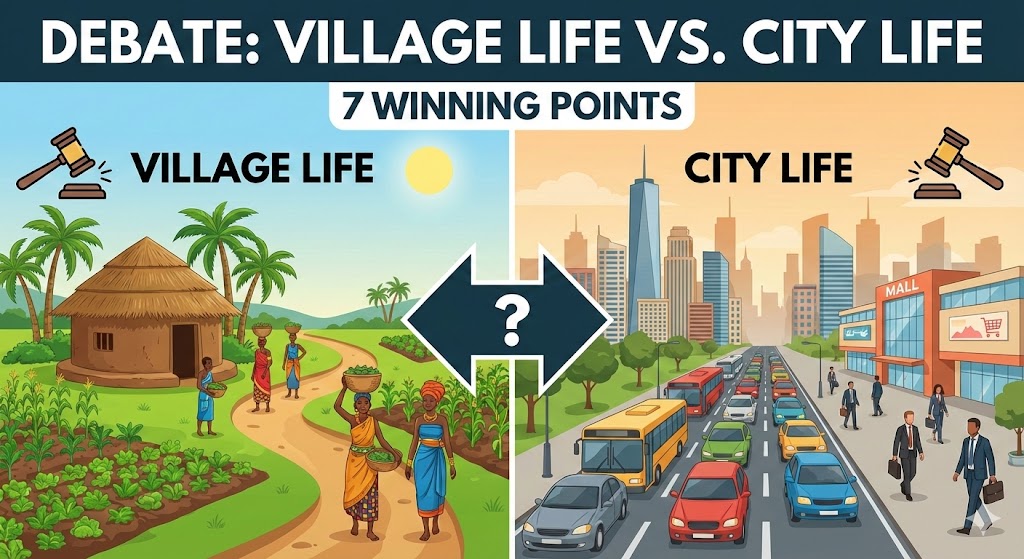
Debate: Village Life is Better Than City Life (7 Winning Points)
Debate: Village Life is Better Than City Life (7 Winning Points)
Good day, students! Looking for the winning points for your next debate? You’ve come to the right place.
We all know this is a classic topic. Every session, students across Nigeria search for strong arguments to back up the claim that the rural areas hold the key to a better life. Today, I’m handing you the script.
If you are compiling your village life is better than city life debate points, the key is to focus on health, peace, and the economy.
Definition of Terms: Before we dive in, let’s simplify things. “Village life” refers to living in a rural setting with a lower population density, focused often on agriculture and community. “City life,” or urban living, is characterized by high population, industries, and often, high stress.
This article provides debate points supporting the motion that village life is better. It is designed for educational purposes and school competitions. Both city and village life have their unique merits.
Winning Debate Points on Why Village Life is Better Than City Life
Here are the arguments you need to silence your opponents. I have written these exactly as you should say them.
1. The Low Cost of Living (Economy)
Mr. Chairman, Panel of Judges, my first and most practical point is the cost of living. Let’s be honest with ourselves. In the city, you pay for everything. You pay for water, you pay exorbitant rent for a “self-contain” that is barely the size of a kitchen, and you pay through the nose for transport.
In the village, the story is different. We don’t spend half our salary just to have a roof over our heads. Housing is affordable, often free if it’s family land. You don’t need to break the bank to survive. While the city dweller is calculating how to stretch their Naira to cover rent and bills, the village dweller is living comfortably within their means. It is simply more economical.
2. Access to Fresh, Organic Food
My opponent might brag about supermarkets and fast food, but do they know what they are eating? In the city, most food is processed, frozen, or filled with preservatives to keep it “fresh” on the shelf.
But come to the village. We eat what we grow. We eat fresh yams, vegetables plucked straight from the soil, and fruits that haven’t been injected with chemicals. This is organic food at its finest. It is healthier, tastier, and practically free. Why pay for a packaged salad in a Lagos mall when you can pick fresh vegetables from your backyard in the village?
3. A Pollution-Free Environment (Health)
Take a deep breath. If you are in the city, you just inhaled generator fumes, car exhaust, and industrial smoke. Air pollution is a silent killer in urban areas. In fact, [according to the World Health Organization (WHO), air pollution is a major environmental risk to health], causing respiratory infections and heart diseases.
Now, picture the village. The air is crisp and clean. We are surrounded by trees that give us oxygen, not factories that give us carbon monoxide. When we talk about village life is better than city life debate points, we are talking about the difference between breathing poison and breathing life. Health is wealth, and the village is the bank.
4. Peace of Mind and Mental Health
The city never sleeps, and that is not a good thing. The noise pollution is constant—honking cars, loud music, generators roaring all night. It creates a high-stress environment that leads to anxiety and hypertension.
In the village, you sleep like a baby. The environment is serene. You wake up to the sound of birds, not the sound of a neighbors’ fighting or traffic sirens. This serene environment does wonders for your mental health. You cannot buy peace of mind, but in the village, it comes free of charge.
5. Stronger Community and Social Security
In the city, you can live in an apartment for ten years and not know the name of the person living next door. Everyone is locked behind high gates and metal doors. It is a lonely existence.
But in the village? We are a family. The communal lifestyle means everyone looks out for everyone. If a child is doing something wrong, a neighbor corrects them. If someone is sick, the community rallies around them. We have a social safety net that money cannot buy. You are never alone in the village.
6. Escape from Traffic Congestion (“Go-Slow”)
Imagine spending four hours in traffic just to get to work, and another four hours to get back. That is the reality of places like Lagos or Port Harcourt. You spend half your life sitting in a bus or car, wasting fuel and time.
In the village, “go-slow” does not exist. You walk freely or ride your bicycle without stress. You own your time. My opponents might say the city has “movement,” but I call it stagnation. In the village, we actually move.
7. Lower Crime Rate and Safety
Finally, let’s talk about safety. The city is a hub for all sorts of crimes—kidnapping, armed robbery, and pickpocketing. You always have to watch your back.
While no place is 100% crime-free, the village is significantly safer. Because everyone knows everyone, it is very hard for a stranger to come in and commit a crime unnoticed. We sleep with our two eyes closed, unlike our city counterparts who live in constant fear.
Frequently Asked Questions (FAQs)
What is the strongest argument for the opposition (City Life)? Usually, they will focus on “Amenities” and “Infrastructure” like electricity, internet, and hospitals. To counter this, you should argue that good health and peace of mind (Village) are more important than electricity (City). After all, what is the use of electricity if you are stressed and sick from pollution?
How do I conclude this debate speech? End with a summary sentence. Something like: “Judges, is it better to be rich and stressed in a polluted city, or healthy and peaceful in a village? The choice is clear.”
Can I use these points for a primary school debate? Yes! These village life is better than city life debate points are simple enough for primary school but strong enough for secondary school. Just adjust the vocabulary slightly if you are in a lower class.
Conclusion / Summary
To wrap this up, the village offers a life of health, peace, community, and affordability. While the city has its bright lights, it also has dark shadows of stress, pollution, and crime.
When you stand on that podium, remember that you are selling a lifestyle of wellness, not just a location.
This article assumes the supporting stance for the purpose of a debate competition. Both urban and rural living play vital roles in the development of our society.
What do you think? Did I miss a key point about the sweet village life? Drop your opinions in the comments section below… Also, feel free to share this post with your coursemates or those in your team!


