Rote Memorization vs. Understanding: Is “La Cram, La Pour” Killing Your Grades?
Rote Memorization vs. Understanding: Is “La Cram, La Pour” Killing Your Grades?
Imagine this scenario.
You are sitting in the exam hall. The invigilator just dropped the question paper on your desk. You’re sweating a little, but you feel confident because you spent the last three nights reading your notebook cover to cover. You memorized every definition word for word.
You look at Question 1. It asks for a definition, but it’s phrased slightly differently than what is in your note.
Suddenly, your mind goes blank.
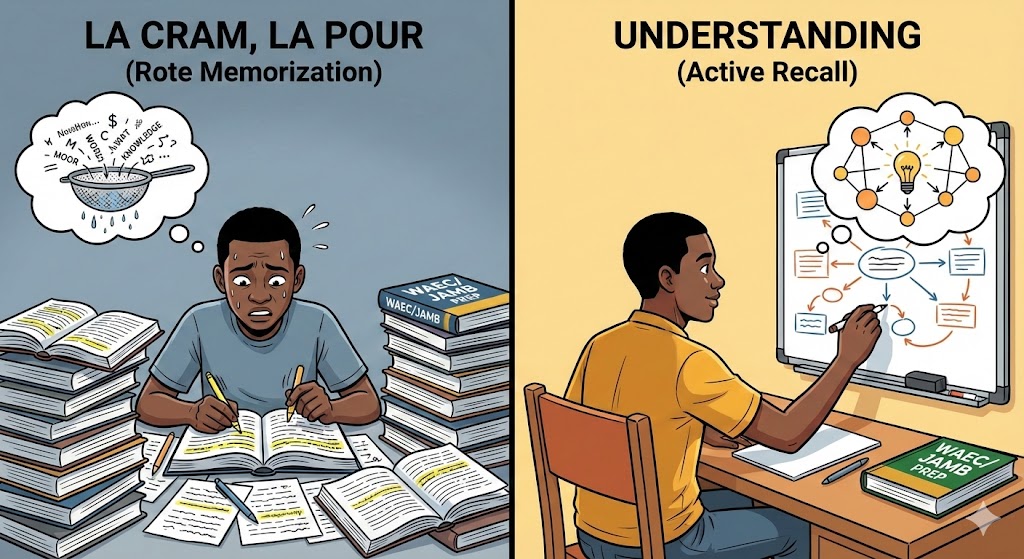
You know the words are somewhere in your head, but because the question twisted the context, you can’t find the answer. This is the classic trap of rote memorization. In Nigeria, we call it “La Cram, La Pour” or “Chew and Pour.” It’s the habit of memorizing information without actually understanding the logic behind it.
I’ve been there. I used to think reading a textbook five times meant I knew the material. But let’s be honest, repeating words like a parrot isn’t learning. It’s just storing data that expires the moment you step out of the exam hall.
What Actually Is Rote Memorization?
At its core, rote memorization is a passive learning technique. It focuses on repetition.
You repeat the state capitals of Nigeria until they stick. You chant the first 20 elements of the periodic table until you can sing them.
Is it useful? Sometimes. You need it to remember phone numbers or your JAMB profile code. But for complex subjects? It’s a disaster waiting to happen.
When you rely solely on rote learning, you aren’t building a web of knowledge. You are just stacking isolated bricks. If one brick (one word in the definition) gets knocked out, the whole wall collapses.
Why “La Cram, La Pour” Fails in WAEC and JAMB
Here is the bitter truth about Nigerian exams like WAEC, NECO, and JAMB. They know you cram.
The examiners are not looking for zombies who can regurgitate definitions. They want to see if you can apply what you’ve learned.
Take Biology for example. If you are studying the JAMB syllabus 2026 for Biology, you might memorize the definition of “Osmosis.” That’s easy.
But the exam question won’t just ask “What is Osmosis?”
They will give you a diagram of a potato strip in a salt solution and ask you to predict what happens to the cell turgidity. If you only crammed the definition, you will fail that question. You need to understand the mechanism of water movement, not just the dictionary meaning.
According to a report by Cornell University’s Learning Strategies Center, relying on recognition (which rote learning provides) gives you a false sense of confidence. You recognize the words, but you can’t use them.
The Better Alternative: Active Recall
So, if cramming is bad, what should you do?
You need to switch to Active Recall. This is the method where you force your brain to retrieve information without looking at your notes.
It’s tough. It feels uncomfortable. But that struggle is where the learning happens.
Here is a simple way I do it:
-
Read a topic (e.g., Economic Supply and Demand).
-
Close the book.
-
Take a blank sheet of paper.
-
Write down everything you remember and try to explain it as if you are teaching a primary school student.
This is often called the Feynman Technique. If you can’t explain it simply, you don’t understand it.
It takes more effort than just reading, but hard work is more important than talent when it comes to retaining knowledge for the long term. A genius who crams will eventually forget; a hardworking student who seeks understanding will remember it for life.
Is Rote Memorization Ever Okay?
I won’t lie to you and say you should never memorize anything.
There are times when rote memorization is necessary. You cannot “understand” a date in history—you just have to remember it. You need to memorize the quadratic formula before you can apply it.
But here is the rule: Understand first, memorize second.
Don’t memorize a physics formula until you know what the variables stand for. Don’t memorize a quote for Literature-in-English until you understand the theme of the book.
This balance is crucial even outside of pure academics. For instance, in vocational education debates, you have to memorize your key points, but you must understand the logic so you can rebut your opponent.
Final Thoughts
We need to stop treating our brains like hard drives and start treating them like muscle.
Cramming is the easy way out. It feels safe because you can recite the words immediately after reading. But it betrays you when the pressure is on.
Start small. Pick one difficult topic today. Don’t just read it. Question it. Draw it. Teach it to your empty room.
It might feel slower at first, but when you see your grades jumping from Cs to As, you’ll realize the extra effort was worth it.
For more tips on effective study habits, check out this guide on exam preparation strategies from the University of North Carolina.