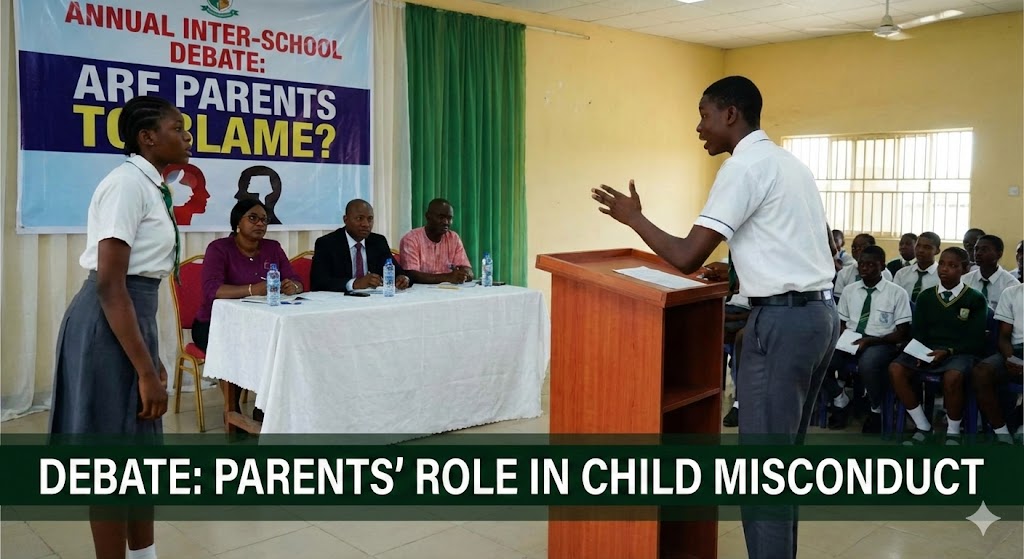
Debate: Parents Are to Be Blamed for the Misconduct of Their Children (5 Winning Points)
Debate: Parents Are to Be Blamed for the Misconduct of Their Children (5 Winning Points)
Good day, students!
Are you preparing to face the panel of judges? Looking for the winning points for your next big speech? You’ve come to the right place.
Today, we are tackling a very hot topic. We are supporting the motion. If you have a debate on parents are to be blamed for the misconduct of their children, you need arguments that hit hard and make sense. You can’t just go there and speak “big grammar” without facts. You need points that the audience can relate to instantly.
What does this motion mean? Simply put, it means that when a child misbehaves in society—whether it’s bullying, stealing, or just being rude—the root cause can be traced back to the home and the parents who raised them.
Please note that this article is a debate template designed for educational purposes. We love and respect our parents! In a debate, you are often assigned a side to defend, regardless of your personal feelings. These points are crafted to help you win that specific argument.

Winning Debate Points on Why Parents Are to Be Blamed
Below are the strong arguments you can copy, adapt, and paste directly into your speech script. I have written them in the first person, so they are ready for you to read out loud.
1. Charity Begins at Home (The Foundation)
Mr. Chairman, panel of judges, and accurate timekeeper, my first and most crucial point is a proverb we all know: “Charity begins at home.” The home is the first school a child ever attends. The parents are the very first teachers.
Before a child meets a friend, a teacher, or a pastor, they have spent years with their parents. If the foundation is weak, the building will collapse. It’s that simple. If a child displays misconduct outside, it is often because they were not taught the correct values inside. You cannot plant yam and expect to harvest cassava. If parents plant discipline and love, they will harvest a well-behaved child. If they plant negligence, they will harvest misconduct.
2. Parents Are the Primary Role Models
Let’s be honest with ourselves. Children are copycats. They don’t do what you tell them to do; they do what they see you do. In this debate on parents are to be blamed for the misconduct of their children, we must look at who the children are imitating.
If a father is always solving issues with violence, why should we be surprised when the son fights in school? If a mother is always lying to her neighbors, why are we shocked when the daughter lies to her teachers? Parents are the mirrors children look into. When a child acts out, they are often just acting out a script written by their parents’ daily behavior.
3. Lack of Supervision and Negligence
We are living in a busy world, I get that. But does being busy justify negligence? No. Many cases of juvenile delinquency stem from a simple lack of supervision.
When parents are too busy chasing money or their careers, they leave their children to be raised by television, the internet, and house helps. Who is checking what they watch? Who is checking who they talk to? When parents are absent, misconduct fills the gap. As noted by experts in child development, according to the World Health Organization, a supportive and attentive home environment is critical for healthy mental and social development. When that attention is missing, trouble starts.
4. Failure to Instill Discipline Early
My opponents might tell you that “peer pressure” is to blame. But I ask you, who prepares the child to face peer pressure? It is the parents!
A child who has been trained with a strong moral foundation at home will not easily sway when friends tell them to do bad things. Misconduct happens when parents fail to discipline their children early. They pamper them when they should correct them. They laugh when the child insults an elder because they think it’s “cute.” Fast forward ten years, and that same child is insulting teachers and breaking laws. The failure to discipline early is a parental failure, period.
5. Emotional Neglect Leads to Acting Out
Finally, let’s look at the psychological side. Not all misconduct is about being “bad.” Sometimes, it is a cry for attention.
When parents are physically present but emotionally absent, children feel invisible. They start acting out—breaking rules, skipping school, causing trouble—just to get their parents to look at them. Even negative attention is better than no attention. So, when we analyze this debate on parents are to be blamed for the misconduct of their children, we see that the bad behavior is often a direct result of the parents’ failure to connect emotionally with their own kids.
Frequently Asked Questions (FAQs)
What if my opponent says “peer pressure” is the real cause? You can rebut (counter) this easily. Tell them that peer pressure is like rain. Every child walks through it. But proper upbringing is the raincoat. If the parents provide a good raincoat (values), the child won’t get wet (misconduct).
How do I start my speech for this topic? Start with a bang! You can say: “They say the fruit doesn’t fall far from the tree. If the fruit is rotten, we must look at the tree.” This immediately grabs the judges’ attention.
Is it okay to use personal examples? Yes, but keep them general. Don’t insult your own parents! Say things like, “We all know that family…” or “Imagine a scenario where…”
Conclusion / Summary
To wrap up, the argument is clear. While society, friends, and schools play a role, the buck stops at the parents’ table. They are the first teachers, the primary role models, and the guardians of the child’s future.
Whether it is through direct bad examples, lack of supervision, or emotional neglect, the root of the problem usually lies at home.
Once again, this article supports one side of the motion for the purpose of an academic debate. Parenting is a difficult job, and many factors influence a child’s behavior. This content is for educational use only.
What do you think? Do you agree that parents carry the biggest load of blame, or is society too harsh on them? Drop your opinions in the comments section below! Also, feel free to share this post with your coursemates or those in your debate team!


