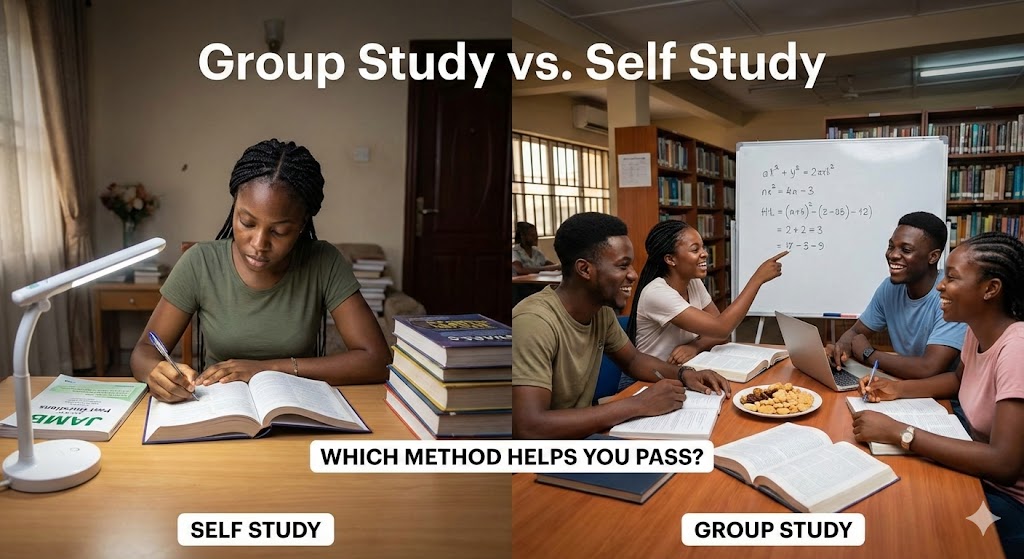
Group Study vs. Self Study: Which Method Actually Helps You Pass WAEC and JAMB?
Group Study vs. Self Study: Which Method Actually Helps You Pass WAEC and JAMB?
Picture this. It’s two weeks before your first WAEC paper. You are sitting at your desk, staring at a Physics textbook that looks like it’s written in Greek. Your phone buzzes. It’s your friend, asking you to come over to the school library for a reading session.
Do you go? Or do you lock your door and grind it out alone?
It’s the question every Nigerian student asks when the pressure mounts: what is a better method, group study or self study?
I’ve been there. I’ve tried the late-night solo candle burning, and I’ve tried the noisy classroom discussions. The truth? Both have serious pros and cons. If you pick the wrong one at the wrong time, you might waste hours doing absolutely nothing.
Let’s break it down so you can choose the strategy that will actually get you that admission.

The Case for Self Study (The “Lone Wolf” Approach)
Self-study is the classic method. It’s just you, your books, and your brain. For many students, this is the default mode, especially when tackling heavy subjects.
Why it works:
1. You Control the Pace When you study alone, you are the boss. If you are a wizard at English but struggle with Biology, you don’t have to wait for anyone. You can skim through the English past questions and spend three hours digging into the jamb syllabus 2026 for biology topics you must read to score high.
In a group, you might be forced to move on before you truly understand a concept just because the majority gets it. Solo study prevents that.
2. Fewer Distractions (Ideally) If you are disciplined, self-study is deep work. There’s no one to ask, “How far with that girl?” or “Did you watch the Chelsea match?” You can enter a flow state where you absorb information rapidly.
The Trap of Solo Reading
However, let’s be honest. Studying alone can be dangerous if you lack discipline.
It’s very easy to zone out. You might read the same paragraph five times without understanding a word. Or worse, you hit a difficult topic, get frustrated, and decide to check Instagram for “just five minutes.” Before you know it, two hours are gone.
Also, if you are stuck on a difficult calculation, you are stuck. There’s no one to ask for help immediately.
The Case for Group Study (The “Squad” Approach)
On the flip side, we have group study. This isn’t just about hanging out with friends; it’s about leveraging other people’s brains to help your own.
Why it works:
1. The “Teacher” Effect There is a saying that you don’t truly know a topic until you can teach it to someone else. In a group, you might explain a Government concept to a friend, and in doing so, it sticks in your brain forever.
This dynamic often proves that hard work is more important than talent. Even if you aren’t the smartest in the room, the effort of explaining and debating answers helps you improve faster than the “genius” studying alone.
2. Motivation and Morale Let’s face it, reading for JAMB is draining. Sometimes you just want to give up. Seeing your friends grinding alongside you can give you that extra push. It’s the same logic behind why a mixed school is better than single school for social development—interaction keeps things lively and prevents boredom.
The “Gist” Problem
Here is the biggest issue with group study in Nigeria: The Gist.
If you are not careful, a “study group” quickly turns into a debate about who the best afrobeats artist is or a complaint session about ASUU. I’ve seen students meet for four hours and study for only thirty minutes. That is a recipe for failure.
The Verdict: It’s Not About One or the Other
So, back to the main question: what is a better method, group study or self study?
The honest answer? Neither is “better.” They are tools for different jobs.
Think of it like building a house. Self-study is laying the blocks. You need to do it yourself. Group study is the inspection. You bring people in to check your work and fix the cracks.
According to research from major educational bodies like The West African Examinations Council (WAEC), students who engage in peer tutoring often retain information longer, but only if they have already done the individual groundwork.
How to Create the Perfect Study Mix (Hybrid Strategy)
Don’t pick one side. Use both. Here is a strategy that works for most high-flying students:
1. Learn Alone, Revise Together Never go to a group study session to learn a new topic from scratch. That’s a waste of everyone’s time.
Use your solo time to read the notes and understand the basics. Then, use the group session to treat past questions or debate difficult answers. This way, you are bringing value to the table.
2. Keep the Circle Small You don’t need a crowd. A group of 3 to 4 focused friends is perfect. Any more than that, and it becomes a market.
3. Solve Administrative Issues Early Nothing kills a study vibe faster than worrying about registration errors or deadlines. Handle your business before you sit down to read. For example, make sure you’ve sorted out any jamb registration issues and solutions fix profile code nin errors fast. If your mind is worried about your NIN or profile code, you won’t focus in the group or alone.
4. Use Debates to Learn Make your group sessions active. Don’t just read silently side-by-side. Pick a controversial topic or a difficult past question and argue it out. For example, you could practice your reasoning skills by discussing topics like debate on vocational education is better than formal education 7 winning points. If you can defend your point, you know the material.
Conclusion
At the end of the day, passing exams in Nigeria isn’t magic. It’s about knowing yourself.
If you know you get distracted easily, lock yourself in a room (Self Study). If you know you fall asleep when reading alone, find a serious partner (Group Study).
Experiment with both. Find your rhythm. And remember, whether you are reading alone in your room or solving math with your guys in the library, the goal remains the same: smashing those papers.
You’ve got this.
(For more official updates on examination timelines, you can always check the Joint Admissions and Matriculation Board (JAMB) official portal).