What is the Best Way to Study for IGCSE? A Practical Guide for Nigerian Students
What is the Best Way to Study for IGCSE? A Practical Guide for Nigerian Students
Let’s be honest for a second. Preparing for IGCSEs can feel completely different from preparing for the Junior WAEC (BECE) or even internal school exams.
The questions are trickier. The marking schemes are strict. And sometimes, it feels like they want you to think like a scientist rather than just a student.
You are probably sitting there, staring at a pile of textbooks, asking yourself: what is the best way to study for IGCSE without burning out or losing your mind?
I’ve been there. I’ve seen students who read 12 hours a day and still get C’s, and students who read smart for 4 hours and bag A*s.
The difference isn’t “juju” or pure talent. It’s strategy.
Here is how you can crush your IGCSEs without turning into a zombie.
1. Understand the “Command Words” (The Secret Code)
If you treat IGCSE Biology or Geography like a normal Nigerian school test where you just “pour” everything you know, you will lose marks.
IGCSE examiners use specific “command words.” These are instructions like Define, Describe, Explain, or Evaluate.
Here is the trap: If the question asks you to Describe a graph, and you start Explaining why the graph looks that way, you get zero marks. Even if your explanation is scientifically correct.
-
Describe: Say what you see.
-
Explain: Say why it happened.
You need to learn this language. It’s almost as important as the subject content itself. As we often say when discussing whether hard work is more important than talent, knowing how to work is what actually counts.
2. The Syllabus is Your Map (Don’t Ignore It)
Most Nigerian students make a huge mistake here. They rely solely on the textbook.
Textbooks are great, but they often contain extra fluff you don’t need. The syllabus (curriculum) is the document the examiners use to write the questions.
If a topic isn’t in the syllabus, it won’t be in the exam. Period.
Go to the official Cambridge International or Edexcel website. Download the syllabus for your specific subject and year.
Use it as a checklist. Tick off every single bullet point as you study. If you can answer every point on that list, you are ready.
This is similar to the strategy used for local exams. For example, checking the JAMB syllabus for Biology helps you avoid reading topics that will never come out.
3. Past Papers: The Holy Grail of Revision
If you are looking for what is the best way to study for IGCSE, this is it.
You cannot pass these exams just by reading notes. You have to practice. But there is a right way and a wrong way to do this.
The Wrong Way: Looking at the question, thinking “Okay, I know this,” and flipping to the answer key.
The Right Way: Sit down. Remove your phone. Time yourself.
Simulate the exam hall pressure. If the paper is 1 hour, give yourself 50 minutes.
This helps you get used to the timing. You don’t want to be the student begging for “extra two minutes” when the invigilator screams “Stop writing!”
Also, mark your own work using the “Mark Scheme.” The Mark Scheme shows you exactly where the marks are. Sometimes, just writing a specific keyword gives you the point.
4. Active Recall: Stop “Just Reading”
I see this all the time in libraries and hostels. Students holding a book open, eyes glazing over, reading the same paragraph for 20 minutes.
That is passive study. It feels like you are learning, but nothing is sticking.
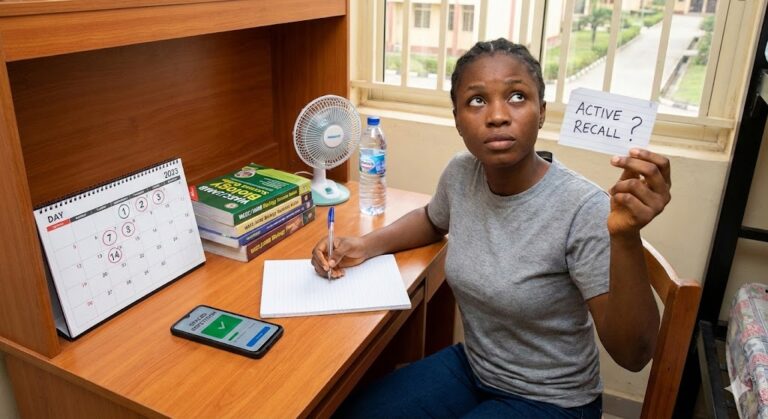
You need “Active Recall.”
Close the book. Take a blank sheet of paper. Scribble down everything you can remember about the topic.
Then open the book and see what you missed. The struggle to remember is where the learning happens. It’s tough, I know. It hurts your brain more than just reading. But that’s how you know it’s working.
This is much more effective than studying in a noisy environment. Although, some argue that a mixed school is better than a single school for social development, when it comes to studying, you need to be in your own zone.
5. Don’t Just “Cram and Pour”
We all know the “La Cram, La Pour” method. It might work for some internal tests, but IGCSE hates it.
These exams test your ability to apply knowledge to new situations.
For example, in Physics, they won’t just ask for the formula for speed. They will give you a scenario about a car traveling between Lagos and Ibadan with specific stops, and ask you to calculate the average speed.
You need to understand the concept, not just memorize the definition.
If you are struggling to understand a concept, don’t just stare at the text. Use resources like BBC Bitesize or Khan Academy. Sometimes hearing a different explanation makes it click.
6. Fix Your Sleep Pattern
This might sound like advice from your mother, but she is right.
Pulling “all-nighters” (TDB – Till Day Break) is actually counterproductive for IGCSEs. Your brain needs sleep to move information from short-term memory to long-term memory.
If you study for 5 hours and sleep for 2, you will likely forget 60% of what you read.
Sleep is part of the study process. Don’t cheat it.
Final Words
So, what is the best way to study for IGCSE?
It comes down to using the syllabus, practicing past papers under timed conditions, and using active recall.
Don’t let the pressure get to you. It’s just an exam. Prepare well, trust your strategy, and you will be fine.
Good luck!