Why Can’t I Remember What I Read for Exams? (5 Reasons & How to Fix It)
Why Can’t I Remember What I Read for Exams
Imagine this scenario.
You spent the last three nights burning the midnight candle. You denied yourself sleep, skipped meals, and read your textbook from cover to cover. You feel ready.
But the moment you sit in that exam hall and the invigilator drops the paper in front of you, your mind goes blank.
You stare at question number one. You know you read this topic yesterday. You can even remember the page color. But the answer? It’s gone. Panic sets in. You start asking yourself, “why can t i remember what i read for exams?”
It is a frustrating experience. It happens to the best students, and it hurts your confidence.
The good news? You aren’t “dull.” Your brain isn’t broken. You are probably just studying the wrong way.
Let’s look at the real reasons why this happens and, more importantly, how to fix it so you can crush your WAEC, JAMB, or semester exams.

“Why can t i remember what i read for exams?” – The Real Causes
If you constantly forget what you study, one of these habits is likely the culprit.
1. You are “Passive Reading” (The Movie Watcher)
This is the most common mistake Nigerian students make.
You open your textbook and read the lines over and over again. You highlight everything with a marker until the whole page is yellow. You feel like you are learning because you recognize the words.
But here is the truth: Recognition is not the same as recall.
When you just read, your brain is passive. It’s like watching a movie. You understand the plot while you are watching, but if someone asks you to explain the full story three days later, you struggle. You aren’t forcing your brain to work; you are just scanning.
2. The “La Cram, La Pour” Trap
We mentioned this in our guide on student habits, but it bears repeating.
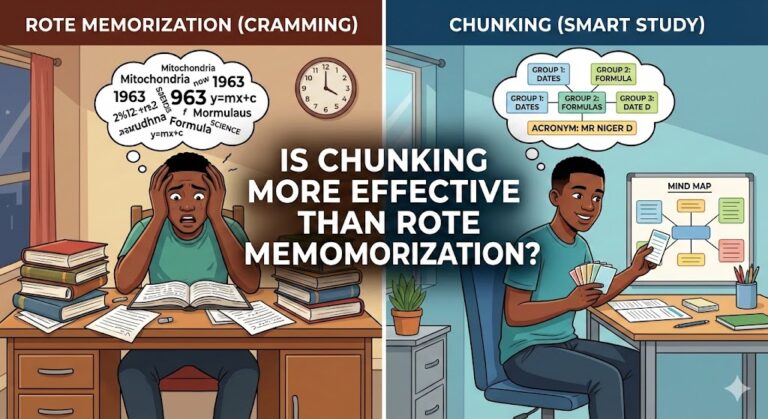
Cramming is a dangerous game. When you try to force-feed your brain an entire term’s worth of Biology or Government in one night, your brain stores that information in its “short-term memory.”
Short-term memory is like a leaky bucket. It holds water for a little while, but it empties fast.
You might remember the definition of “Osmosis” for the first 10 minutes of the exam. But the moment you see a twisted question that requires deep understanding, the cramming fails you. As we often say, hard work beats talent, but it has to be smart work, not just last-minute rushing.
3. You are Studying Without a Plan
Are you just picking up any book that is close to you?
Many students fail to retain information because their study session is chaotic. You read Chemistry for 10 minutes, get bored, switch to English, then check your phone. Your brain gets confused.
Also, are you reading topics that aren’t even in the exam?
For exams like JAMB, you must check the official syllabus topics before you start reading. If you load your brain with irrelevant topics, you take up space meant for the important stuff.
4. Fatigue: Your Brain is on Low Battery
This is where the “Naija student” mentality works against you. We believe that if you aren’t suffering, you aren’t reading.
So you drink coffee, wash your face with cold water, and refuse to sleep.
But here is the science: Your brain needs sleep to move information from short-term memory to long-term memory. It’s like clicking “Save” on a Word document. If you don’t sleep, you haven’t clicked save. You might read for 10 hours, but if you don’t rest, you’ll wake up remembering almost nothing.
How to Make It Stick (The Solutions)
So, how do we fix this? How do you ensure that when you ask, “why can t i remember what i read for exams,” the answer is “I actually do remember”?
1. Stop Reading, Start Testing (Active Recall)
This is the game-changer.
Instead of reading a page four times, read it once. Then, close the book.
Ask yourself: “What did I just read?”
Try to explain it out loud to an imaginary class. If you can’t explain it without looking at the book, you don’t know it yet. This method is called Active Recall. It forces your brain to dig for the answer, which creates a stronger memory pathway.
It feels harder than just reading. It will make your head hurt a little. That means it’s working.
2. Clear Your Head (And Your Timetable)
Stress kills memory. When you are panicked about registration deadlines or profile codes, your brain shuts down.
Try to sort out your administrative issues early. For example, knowing the official timeline for JAMB registration helps you relax and focus purely on studying.
Also, create a strict timetable. Don’t multitask. Give a subject your full attention for 45 minutes, then take a break.
3. Use Official Resources
Don’t depend on “key points” pamphlets sold at the bus stop. Stick to the recommended texts.
For major exams, the exam bodies usually tell you exactly what they want. Using the correct resources gives you confidence. You can verify requirements on the official JAMB website or the WAEC portal. When you trust your source, you second-guess yourself less in the exam hall.
4. Sleep is Not for Lazy People
Change your mindset about sleep.
Sleep is a study tool. Aim for at least 6-7 hours of sleep, especially during exam week.
If you study effectively for 4 hours and sleep for 7 hours, you will remember more than the student who studies for 10 hours and sleeps for 1. It sounds counter-intuitive, but it’s true.
Conclusion
It’s normal to feel scared when you forget things. But remember, the volume of what you read doesn’t matter as much as how you read it.
Shift from passive reading to active testing. Get some rest. Follow the syllabus.
If you do these things, you won’t just memorize; you will understand. And once you understand, you won’t forget.
Good luck with your exams! You’ve got this.