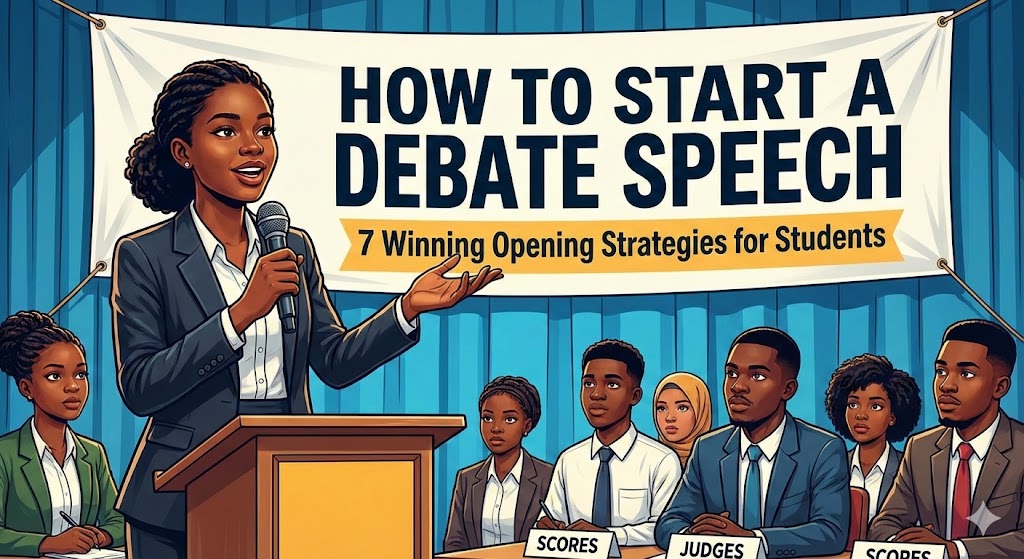
How to Start a Debate Speech: 7 Winning Opening Strategies for Students
How to Start a Debate Speech: 7 Winning Opening Strategies for Students
Imagine this scenario.
You are standing on the stage or in front of the class. The hall is quiet. The timekeeper has their finger on the stopwatch. The judges are staring at you with their pens ready. Your palms are sweaty.
What comes out of your mouth first?
For most students, the first 30 seconds determine whether they win or lose. If you bore the judges, you lose marks. If you grab their attention, you are halfway to victory.
I’ve watched countless debates in secondary schools and universities, and I see the same errors over and over. Today, I’m going to show you how to start a debate speech the right way.
These are techniques that will make the judges sit up and listen.
The Biggest Mistake Students Make
Let’s be honest. 90% of students start their debate like this:
“Good day Mr. Chairman, panel of judges, accurate timekeeper, co-debaters, and my fellow students. My name is Emeka and I am here to support the motion that…”
Boring.
By the time you finish that long list of greetings, the judges are already looking at their phones or checking the time. You have wasted your “power moment.”
While greetings are important (we will get to that later), they should not be your very first sentence. You need a “Hook.”
Here are the best ways to open your speech.
1. The Storyteller (Paint a Picture)
Humans love stories. It’s in our DNA.
Instead of going straight to your points, paint a picture of the reality you are describing. If you can make the judges “see” what you are talking about, you have won their hearts.
For example, if you are arguing that village life is better than city life, don’t just say “The village is quiet.”
Say this instead: “Imagine waking up to the sound of fresh breeze and cocks crowing, not the noise of generators and traffic. Imagine eating food fresh from the farm, not preserved with chemicals.”
You see the difference? You have transported the audience immediately.
2. The Shocking Statistic (The Fact Bomber)
Numbers don’t lie.
Starting with a heavy statistic shows the judges that you have done your research. It makes you look like an expert immediately.
If you are debating about the education sector, you could check data from reputable sources like UNICEF Nigeria regarding out-of-school children.
Your opening could look like this: “Did you know that over 10 million children in Nigeria are currently out of school? This is not just a number; it is a crisis.”
This grabs attention instantly. It sets a serious tone for your argument.
3. The Rhetorical Question (The Thinker)
This is one of the easiest and most effective ways to learn how to start a debate speech.
Ask a question that forces the audience and the judges to think. You don’t want them to answer out loud; you want them to answer in their heads.
Let’s say you are proposing the motion that hard work is more important than talent.
You could open with: “Is natural talent enough to take you to the top of the world, or is it the sweat and sleepless nights that truly count?”
This engages the brain immediately. It sets the stage for your points perfectly.
4. The Powerful Quote
Using a quote from a famous person can add “weight” to your speech. It borrows authority from someone else.
However, don’t use overused quotes like “A pen is mightier than the sword.” We are tired of hearing that one. Find something unique.
If you are debating that leadership is the problem of this country, you might quote a famous African leader or a writer like Chinua Achebe regarding the trouble with Nigeria.
Say: “Chinua Achebe once said, ‘The trouble with Nigeria is simply and squarely a failure of leadership.’ Today, I am here to prove why that statement is 100% true.”
5. The “Prop” Method
This is risky, but if allowed, it is a game-changer.
Walk to the podium holding an object related to your topic.
If you are arguing that corporal punishment should be abolished, you could hold up a cane.
Look at the cane, look at the audience, and say: “Is this a tool for correction, or is this a weapon of fear? Today, I want us to look at this object differently.”
Note: Check with your debate coordinators first to see if props are allowed.
Where Do I Put the Greetings? (The “Naija” Protocol)
I know what you are thinking. “But sir, if I don’t greet the Chairman, they will say I am rude!”
You are right. In Nigeria, respect is everything. You cannot skip the greetings.
But here is the trick: Hook first, Greet second.
Here is the perfect formula:
-
The Hook: Start with your story, question, or stat (15 seconds).
-
The Greeting: “With this thought in mind, Good day Mr. Chairman, panel of judges, and accurate timekeeper…”
-
The Stance: “My name is Tunde, and I am here to propose the motion…”
This method is sophisticated. It shows you are a master speaker who knows how to control an audience, but you are also respectful.
Things to Avoid in Your Opening
To truly master how to start a debate speech, you must know what to avoid.
-
Don’t Apologize: Never start with “I’m a bit nervous” or “I’m not feeling well.” The judges don’t care. Fake confidence if you have to.
-
Don’t Look Down: Look at the audience. Eye contact is powerful. According to Toastmasters International, eye contact builds an instant connection.
-
Don’t Define Every Word: We know what “Education” means. We know what “School” means. Don’t bore us with “According to the Oxford Advanced Learner’s Dictionary…” unless the definition is the core part of your argument.
Final Thoughts
Debating is not just about who has the best points; it is about who can sell those points the best.
Your opening is your sales pitch.
If you use the strategies above—painting a picture, using strong stats, or asking the right questions—you will have the judges on your side before you even make your first point.
So, for your next debate, don’t just walk up there and mumble a greeting. Go up there and command the room.
Which of these opening strategies will you try in your next debate? Let me know in the comments!