The 1/3, 5/7 Study Rule: The Secret to Passing JAMB and WAEC Without “La Cram La Pour”
The 1/3, 5/7 Study Rule: The Secret to Passing JAMB and WAEC Without “La Cram La Pour”
Imagine this scenario.
You are sitting in the exam hall. The invigilator places the paper in front of you. You look at Question 3. You know you read this topic just last week. You can even remember the color of the textbook page.
But the answer? It’s gone. It has vanished.
It’s painful, right? This happens to thousands of Nigerian students every year during WAEC and JAMB. It’s not because you aren’t smart. It’s usually because your study method is broken.
If you are tired of reading for hours only to forget everything the next day, you need a system. That is where the what is the 1/3, 5/7 rule in studying question comes in. It is a formula that changes how you absorb information so it actually sticks in your brain.
Here is the honest truth: Hard work alone isn’t enough. You need a strategy.

What Exactly is the 1/3, 5/7 Rule in Studying?
Let’s keep this simple. No big grammar.
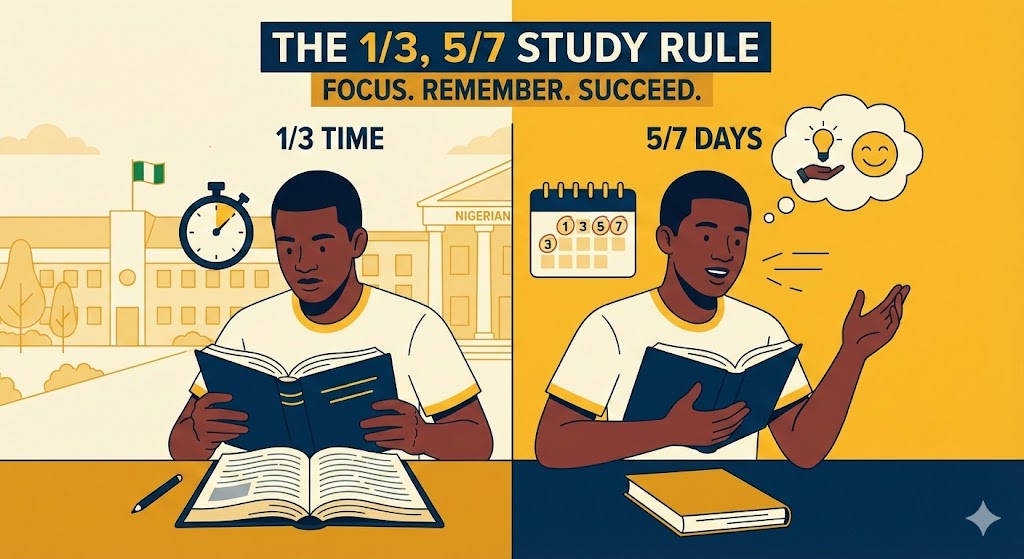
The rule is actually a combination of two powerful psychological tricks: Active Recall and Spaced Repetition.
When most students study, they just read. They open their notes, highlight a few lines, and nod their heads. They feel like they are learning. But they are just recognizing the words, not memorizing them.
The 1/3, 5/7 rule forces your brain to work harder.
-
The 1/3 Rule tells you how to spend your study session (Time allocation).
-
The 5/7 Rule tells you when to review what you studied (Scheduling).
Let’s break them down so you can use them for your next test.
Part 1: The 1/3 Rule (Stop Just “Reading”)
Here is a mistake I see all the time. A student has 3 hours to study Biology. They spend 2 hours and 50 minutes reading the textbook. Then they spend 10 minutes skimming over it again.
That is a waste of time.
The 1/3 rule suggests a better split: Spend 1/3 of your time reading, and 2/3 of your time reciting.
If you have one hour to study:
-
First 20 Minutes (1/3): Read the material. Understand the concepts. Look at the diagrams.
-
Next 40 Minutes (2/3): Close the book. Yes, close it. Now, try to say what you learned out loud. Write it down from memory. Teach it to an imaginary class.
Why does this work?
When you just read, your brain is passive. It’s like watching a football match; you aren’t actually playing. But when you close the book and force yourself to remember, you are playing the match. You are strengthening the neural pathways in your brain.
This is especially useful when tackling heavy subjects. For example, if you are looking at the JAMB syllabus 2026 for Biology, don’t just stare at the topics. Read a topic for 15 minutes, then spend 30 minutes answering past questions on it without looking at your notes.
Part 2: The 5/7 Rule (Beating the Forgetting Curve)
Okay, so you used the 1/3 rule and you learned the topic. Good job.
But here is the problem: You will forget it.
Human brains are designed to forget things we don’t use. Scientists call this the “Forgetting Curve.” If you study Physics on Monday and don’t look at it again until the exam in a month, you will likely remember only about 10-20% of it.
The 5/7 rule is about when you review. It suggests reviewing on specific days to reset that forgetting curve.
-
Day 1: You learn the topic (using the 1/3 method).
-
Day 3: You review the topic briefly.
-
Day 5: You review it again.
-
Day 7: You do a final weekly review.
You don’t need to study it for hours on these review days. Just 10-15 minutes is often enough to remind your brain, “Hey, this information is important, keep it.”
According to research by the University of Waterloo on the Forgetting Curve, reviewing information within 24 hours and then again later in the week drastically increases retention. It stops the memory from fading away.
Why This Beats “La Cram, La Pour”
We all know the “La cram, la pour” method. You stuff your head the night before the exam, pour it out on the paper, and forget it five minutes later.
That might work for a simple class test. But for JAMB? Or Post-UTME? It’s risky.
The questions in these major exams are twisted. They test your understanding, not just your ability to memorize a definition. If you only crammed, you will get confused when you see a tricky question.
Using the 1/3, 5/7 rule builds long-term memory. It turns you from a student who is just trying to survive into a scholar who actually understands the work.
Plus, consider the cost. Parents struggle to pay school fees and exam fees. When you look at the price of the JAMB form 2026, you realize that failing isn’t just about grades; it’s about wasting hard-earned money.
How to Use This Today (Step-by-Step)
Ready to try this? You don’t need to change your whole life. Just tweak your routine.
-
Pick Your Topic: Let’s say you want to study Government.
-
Set a Timer: If you plan to study for 60 minutes, set a timer for 20 minutes.
-
Read (20 mins): Read the chapter intensely. No phone. No WhatsApp.
-
Recite (40 mins): Close the book. Write down everything you remember. Where did you get stuck? Open the book, check that part, close it, and try again.
-
Mark Your Calendar: If today is Monday, write “Review Government” on your calendar for Wednesday (Day 3), Friday (Day 5), and Sunday (Day 7).
It sounds like a lot of work, I know. And I won’t lie to you, it is harder than just lazily reading a textbook. But as we often say, hard work is more important than talent. The lazy student reads once and forgets. The smart student reviews.
For more on effective study techniques like Spaced Repetition, you can check out resources like Khan Academy’s guide to studying. They break down why spacing out your reading beats cramping it all into one night.
Final Thoughts
The 1/3, 5/7 rule isn’t magic. It won’t write the exam for you. But it is one of the best ways I’ve found to stop that terrible feeling of blanking out in the exam hall.
Give it a try for one week. Just one week. See if you don’t remember more than you usually do.
What is your biggest struggle when reading for exams? Do you fall asleep or do you just forget? Let me know in the comments below!