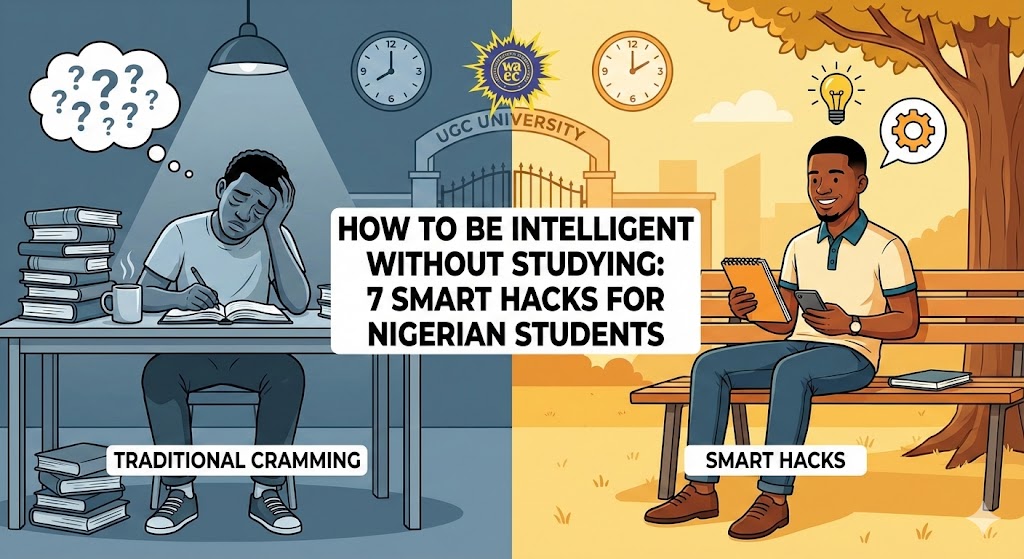
How to Be Intelligent Without Studying: 7 Smart Hacks for Nigerian Students
How to Be Intelligent Without Studying: 7 Smart Hacks for Nigerian Students
Ever looked at that one guy in your class who never seems to open a book but still blasts A’s?
It’s annoying, isn’t it?
You are there, burning the midnight candle, drinking coffee to stay awake, and stressing over every page. Meanwhile, they are playing football or pressing their phone, yet when the results come out, they top the class. You start wondering if they are using “juju” or if they are just naturally gifted.
Here is the secret: They aren’t necessarily smarter than you. They just know how to be intelligent without studying in the traditional, boring, painful way.
Intelligence isn’t just about how many hours you stare at a textbook. It’s about how your brain processes information. If you want to boost your grades without turning into a zombie, you need to stop working hard and start working smart.
Here are the hacks that the “smartest” students use to ace WAEC and JAMB without suffering.

1. Master the Art of “Classroom Theft”
I call this “Classroom Theft” because you are stealing knowledge directly from the teacher so you don’t have to buy it back with your time later.
Here is the mistake most students make: They zone out in class. They sleep, make noise, or chat, telling themselves, “I will read this topic when I get home.”
That is a trap.
When you learn a topic fresh on your own, it takes 2 to 3 hours to understand it. But if you listen actively in class—asking questions and taking rough notes—your brain has already done 70% of the work. When you get home, you aren’t “studying”; you are just revising.
I’ve noticed that students who engage in class debates or ask questions tend to remember facts longer. For example, engaging in a debate on whether leadership is the problem of this country forces you to think on your feet. That’s real intelligence.
2. The Syllabus is Your Map (Don’t Read Blindly)
Imagine trying to find a location in Lagos without Google Maps. You will suffer.
Reading without checking the syllabus is the same thing. Being intelligent means knowing exactly what the examiner wants. You don’t need to know everything in the textbook; you only need to know what is in the syllabus.
For instance, if you are preparing for JAMB, don’t just pick up a biology textbook and start reading from page one. That is a waste of time. You need to look at the specific areas JAMB focuses on. We broke this down in our guide on the JAMB syllabus 2026 for Biology, showing you exactly which topics are “hot cakes.”
Smart students ignore the fluff and focus on the core topics. You can download the official syllabus brochures directly from the JAMB IBASS website to see exactly what is required for your course.
3. The Feynman Technique (Teach to Learn)
This is one of the most powerful psychological tricks in the world.
The idea is simple: You don’t truly understand a topic until you can explain it to a 5-year-old (or your younger sibling).
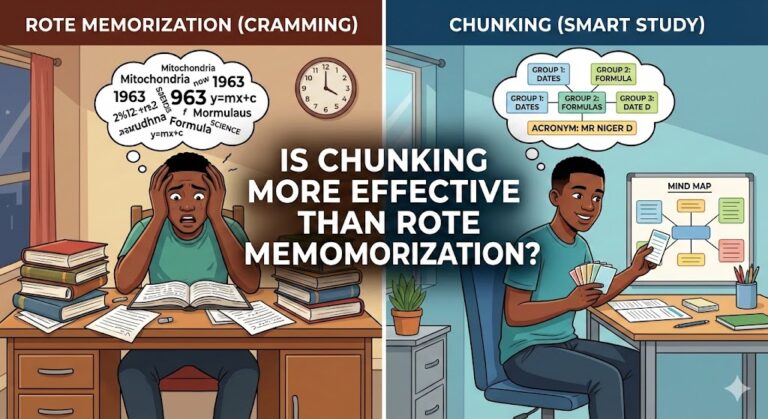
Instead of memorizing definitions like a robot, try to explain the concept in plain Pidgin or simple English to a friend. If you get stuck or can’t explain it simply, it means you don’t know it yet.
Go back, check the gap, and try again. This method builds deep understanding, not just surface-level memorization. It’s faster than rote learning and sticks in your brain longer.
4. Pattern Recognition (The Past Question Cheat Code)
Let’s be honest. WAEC, NECO, and JAMB are not reinventing the wheel every year. They repeat questions.
A student who reads the whole textbook but ignores past questions is working hard. A student who studies the last 10 years of past questions and notices the patterns is working smart.
You will realize that for subjects like Physics or Government, the examiners love specific topics. They twist the questions, but the answer is the same. Intelligence is spotting that pattern.
However, don’t just cram the answers. Understand how they arrived at the answer. This is where the debate of talent vs. effort comes in. As I’ve written before, hard work is more important than talent, but smart work beats both of them.
5. Stop the “TDB” (Till Day Break) Madness
There is this culture in Nigerian universities and secondary schools that if you haven’t done “TDB,” you haven’t read.
That is a lie.
Your brain needs sleep to consolidate memory. If you stay awake all night reading, your brain is too tired to store that information. You will get to the exam hall and blank out.
Research from the Sleep Foundation shows that teenagers need significant sleep for cognitive function. Being intelligent means treating your brain like an expensive engine. You can’t run it on empty. Sleep well, drink water, and study in short, focused bursts (like 45 minutes) rather than 10-hour marathons.
6. Be Curious About the World
True intelligence isn’t just about passing Chemistry or unexpected tests. It’s about connecting dots.
Read news. Watch documentaries. understand how the world works. When you have a broad general knowledge, you can often “guess” answers in exams intelligently because you understand the context.
For example, if you understand current affairs, a Government question about the 1999 constitution becomes easier because you know the history behind it.
7. Organize Your Life
Chaos kills intelligence.
If you are always looking for your pen, looking for your handout, or rushing because you are late, your brain is in panic mode. You can’t think clearly in panic mode.
Get your logistics sorted early. Whether it’s knowing the closing date for JAMB registration or having your pencils ready for WAEC, organization frees up your brain power to focus on the actual exam.
Final Thoughts
Being “intelligent without studying” doesn’t mean you never look at a book. It means you don’t waste time looking at the wrong things in the wrong way.
It’s about strategy. It’s about confidence.
So, the next time you see that huge textbook, don’t be intimidated. Break it down, use the syllabus, and get enough sleep.
Which of these hacks are you going to try first? Let me know in the comments section.