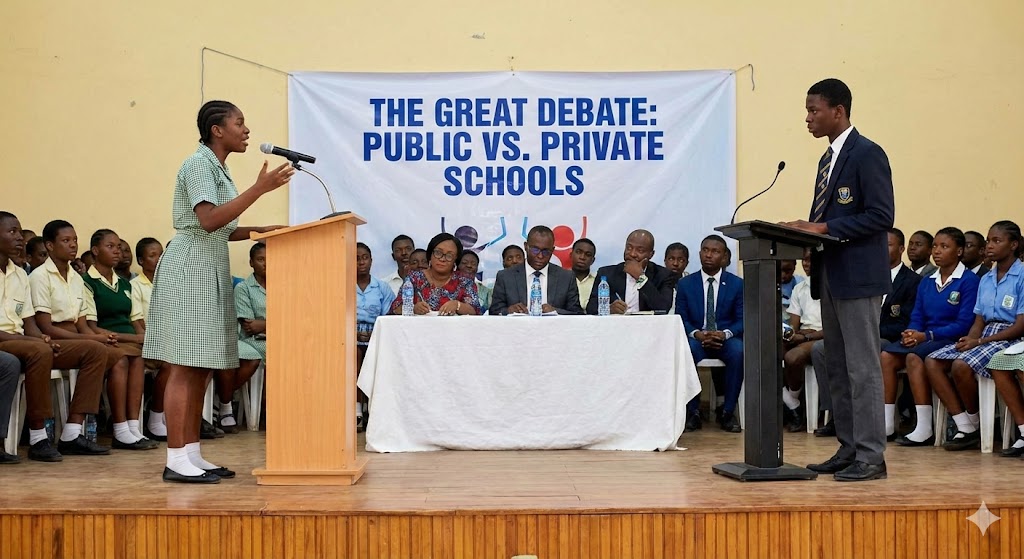
Debate: Public Schools Are Better Than Private Schools (7 Winning Points)
Debate: Public Schools Are Better Than Private Schools (7 Winning Points)
Good day, students! Or should I say, future debate champions?
If you are preparing to face the panel of judges and argue that government-owned institutions are superior, you need strong, logical arguments. You can’t just go there and shout; you need facts. You are in the right place because I’ve compiled the ultimate list of public schools are better than private schools debate points that will help you silence your opposition.
Before we dive into the script, let’s clarify what we are talking about. Public schools are educational institutions funded and managed by the government to ensure every child has access to knowledge. Private schools, on the other hand, are owned by individuals or organizations, often run as businesses.
This article provides arguments supporting the motion that public schools are better than private schools for the purpose of academic debates. It is strictly for educational use and does not mean private schools are not valuable.

Winning Debate Points on Why Public Schools Are Better Than Private Schools
Here are 7 solid points written exactly how you should say them. Pick the ones that resonate with you and deliver them with confidence.
1. Education is a Right, Not a Business
Mr. Chairman, panel of judges, accurately capturing the essence of education is vital. My first and most powerful point is that public schools view education as a fundamental human right, while private schools often view it as a business.
Think about it. In a public school, the primary goal is to educate the Nigerian child, regardless of their background or financial status. We are not customers; we are students. In many private schools, the focus shifts to profit margins and keeping parents happy just to pay the next term’s fees. Is education meant to be a commercial transaction? No. Public schools ensure that inclusive education is available to everyone, rich or poor.
2. Highly Qualified and Certified Teachers
Let’s be honest about who is teaching us. In the public sector, the standard for hiring teachers is incredibly high. You strictly cannot teach in a government secondary school without the proper qualifications—usually a minimum of an NCE (National Certificate in Education) or a Bachelor’s in Education, and registration with the Teachers Registration Council of Nigeria (TRCN).
Compare that to many low-cost private schools that employ secondary school leavers or unqualified staff just to cut costs. In public schools, the teachers are career civil servants. They have job security, pension schemes, and regular training. This stability allows them to focus on one thing: teaching.
3. Affordability and Accessibility
My opponent might argue about facilities, but what is the use of a “fancy” school if 70% of the population cannot afford it? The most significant advantage here is that public schools are better than private schools debate points often ignore: accessibility.
Public education is either free or very low-cost. This removes the financial barrier that keeps millions of children out of school. According to data on global education standards, specifically from organizations like UNESCO, making education free is the only way to achieve mass literacy. Public schools bridge the gap between the rich and the poor, ensuring that a driver’s son can sit in the same class as a doctor’s son and get the same certificate.
4. Adherence to the National Curriculum
There is a structure in public schools that you rarely find elsewhere. Public schools strictly follow the national curriculum standards set by the Ministry of Education. There are no shortcuts.
In some private establishments, they might skip difficult topics or rush through the syllabus just to make students “appear” intelligent to their parents. In public schools, the scheme of work is followed religiously. This ensures that students are genuinely prepared for external exams like WAEC and NECO, rather than just being “coached” to pass. We learn the subject matter thoroughly, not just how to answer specific questions.
5. Real-World Social Integration
Now, let’s look at the social aspect. Public schools are a melting pot of cultures, religions, and social classes. When you attend a public school, you meet people from every walk of life.
This is a diverse learning environment that prepares you for the real world. In a private school, you are often surrounded by people of the same social status—a bubble. But out there in the labor market or the university, you won’t be in a bubble. Public school students develop grit, resilience, and the ability to interact with anyone. We don’t just learn algebra; we learn life.
6. Standardized Grading and Discipline
Have you ever heard of “paying for grades”? It is an ugly truth in some corrupt private systems where parents pressure owners for good results because they are paying heavily. In public schools, that pressure doesn’t exist.
Teachers in government schools have the autonomy to grade students fairly. If you fail, you repeat the class. It sounds harsh, but it is necessary for growth. This strict adherence to standards builds character. We earn our grades. This integrity is why many public school graduates often excel when they get to the university level—they are used to working hard for their results without a safety net.
7. Better Space and Infrastructure
Finally, let’s talk about the physical environment. I’m not talking about air conditioners; I’m talking about space. Most public schools sit on acres of land. We have full-sized football pitches, running tracks, and agricultural farms for practicals.
Many private schools today are essentially converted apartment blocks or residential buildings with no space for children to run or play. A child needs space to grow. The government allocates land specifically for education, ensuring we have the recreational facilities needed for a complete cost-effective education.
Frequently Asked Questions (FAQs)
What is the strongest argument for the opposing side? The strongest argument against public schools usually revolves around infrastructure maintenance or strikes. However, you can counter this by focusing on the quality of teachers and the curriculum, which often outweigh physical building aesthetics.
How should I end my debate speech? End with a strong summary. Remind the judges that while private schools have their perks, public schools serve the nation, not just a few individuals. End with a memorable quote or a direct question to the audience.
Can I use these points for a primary school debate? Yes, you can! Just simplify the language a bit. Instead of saying “Social Integration,” you can say “We make friends with everyone.”
Conclusion / Summary
To wrap this up, the argument that public schools are better than private schools debate points towards one truth: Education should be a service to humanity, not a commercial product.
From having highly qualified, government-certified teachers to offering a diverse social environment and adhering strictly to the national curriculum, public schools provide a realistic and solid foundation for the Nigerian child.
Both public and private schools play a vital role in our educational ecosystem. This article is a guide for students preparing for a debate and supports specifically the “Proposition” side of the motion.
What do you think? Did I miss any winning points? Drop your opinions in the comments section below… Also, feel free to share this post with your coursemates or those in your team!


