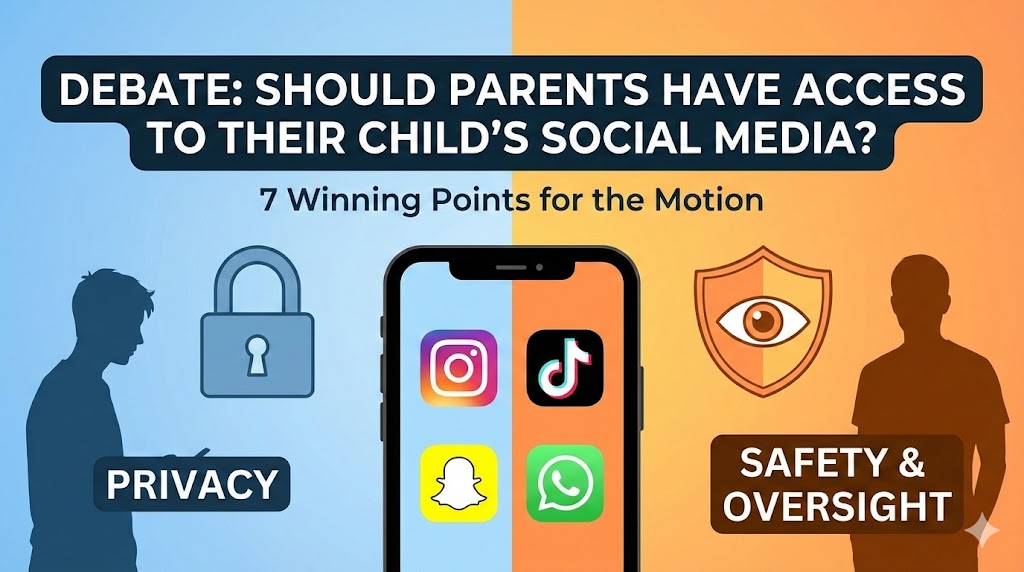
Debate: Should Parents Have Access to Their Child’s Social Media? (7 Winning Points)
Debate: Should Parents Have Access to Their Child’s Social Media? (7 Winning Points)
Good day, students!
Looking for the winning points for your next debate? You’ve come to the right place.
Today, we are diving into a hot topic that affects almost every student in Nigeria: the should parents have access to their child’s social media debate. It’s a controversial topic, but if you are supporting the motion, you need strong, logical arguments that go beyond just saying “parents know best.”
In this post, I will give you the exact script to use to win the judges over. We will define “access” not as spying, but as parental guidance to ensure safety in a digital world.
This article provides debate points supporting the motion that parents SHOULD have access. This is for educational purposes to help students prepare for academic debates and does not diminish the valid arguments for privacy on the opposing side.
Winning Debate Points on Why Parents Should Have Access
Here are 7 high-impact points you can copy, adapt, and present to crush your opponent.
1. Protection from Online Predators and Grooming
Mr. Chairman, panel of judges, my first point is about safety. The internet is not a playground; it is a public street where anyone can walk up to a child. We often hear about “stranger danger” in the physical world, but we forget it exists online too.
The reality is scary. Online grooming is real. Predators use fake profiles to befriend young students, pretending to be their age to build trust. If a parent has access to their child’s account, they can spot these red flags early. They can see the weird messages from “friends” who ask for pictures or private meetups.
Without that access, a child is left to fight these adults alone. By the time the child realizes something is wrong, it might be too late. Access is not about being nosy; it’s about being a shield.
2. Preventing Cyberbullying Before It Escalates
Let’s be honest. Cyberbullying is one of the biggest issues facing students today. It’s easy to be mean when you are hiding behind a screen. But here is the thing: many victims of cyberbullying suffer in silence. They are too scared or ashamed to tell anyone.
If my parents have access to my social media, they can see the signs. They can notice if I am being harassed in a group chat or if people are leaving nasty comments on my posts. This allows them to step in, report the bullies, or give me the emotional support I need before I sink into depression.
[According to a report by UNICEF on child safety online], children who experience online bullying often face severe anxiety. Parental monitoring is the bridge that connects a suffering child to the help they desperately need.
3. Managing the Dangerous “Digital Footprint”
My opponents will scream about “privacy,” but what about our future? Everything we post online stays there forever. It creates a digital footprint. As teenagers, we don’t always think about the long-term consequences of that “funny” video or that angry rant we posted.
Parents act as a second pair of eyes. They have the wisdom to look at a post and say, “Don’t post that, it might hurt your chances of getting a job in the future.”
If parents have access, they can guide us to delete things that could ruin our reputation before we even leave secondary school. It is not controlling; it is quality control for our future success.
4. Curbing Social Media Addiction
We all know that one student who is always on their phone, even during class. Social media is designed to be addictive. It hooks us with likes, comments, and endless scrolling. As children, our brains are still developing, and we often lack the self-discipline to stop.
This is where parents come in. If they have access, they can see how much time we are spending on TikTok or Instagram. They can see if we are chatting late at night when we should be sleeping or studying.
By monitoring our activity, they can help us set boundaries. They can ensure we are not trading our grades and our sleep for a few likes on a screen.
5. Exposure to Inappropriate Content
The internet is full of things no child should see. Violence, pornography, and dangerous challenges are just one click away. Even with strict settings, these things slip through the cracks.
When parents have access to our feeds, they know what we are consuming. They can spot if the algorithm is feeding us toxic content—like videos that promote eating disorders or dangerous stunts.
You cannot protect a house if you don’t know what is coming through the front door. In the same way, parents cannot protect our minds if they don’t know what is entering through our screens.
6. Guidance is Better Than Correction
My opponent might say, “Just trust your child!” But trust is not a strategy for safety. You don’t let a learner driver take the car alone on the highway just because you “trust” them. You sit in the passenger seat to guide them.
Social media is that highway. Having access allows parents to teach us responsible digital behavior in real-time. If they see us being rude to someone online, they can correct us immediately.
This turns social media into a learning tool rather than a weapon. It helps us become better digital citizens because we know we are being guided.
7. The Legal and Financial Responsibility
Finally, let’s look at the facts. In the eyes of the law, until we are 18, our parents are responsible for us. If a child uses social media to commit a crime—like libel, spreading fake news, or sharing illegal content—it is the parents who often face the consequences.
If they are the ones buying the data, buying the phone, and facing the legal risks, surely they have the right to see how that device is being used? It is unfair to ask parents to bear all the risks but give them none of the oversight.
Frequently Asked Questions (FAQs)
What is the strongest argument against this motion? The strongest argument for the opposing side is usually “Privacy.” They will argue that children need a private space to develop their own identity and that monitoring destroys trust. You should prepare to counter this by saying safety is more important than privacy.
How do I start my speech? Start with a hook! You can ask a rhetorical question like, “If you wouldn’t let a stranger into your child’s bedroom at night, why let them into their phone?” This immediately grabs the judges’ attention.
Does “access” mean reading every single message? Not necessarily. You can define “access” in your debate as having the password or the ability to check. It doesn’t mean the parent is hovering over the child’s shoulder 24/7, but that they have the key to enter if they suspect danger.
Conclusion / Summary
To wrap up, the should parents have access to their child’s social media debate comes down to one thing: Safety versus Privacy.
We have discussed how parental access protects children from predators, prevents cyberbullying, saves their digital footprint, and helps curb addiction. While privacy is nice, safety is non-negotiable. We cannot let children navigate the dangerous waters of the internet alone.
This article is a debate template supporting one side of the motion for educational purposes. Both privacy and safety are important aspects of parenting, and every family must find their own balance.
What do you think? Drop your opinions in the comments section below… Also, feel free to share this post with your coursemates or those in your team!


