9 Memorization Tips for Studying That Actually Work (Stop Cramming)
9 Memorization Tips for Studying That Actually Work (Stop Cramming)
Ever spent five hours reading for a Biology test, only to enter the exam hall and have your brain go completely blank?
It’s painful. You stare at the paper, sweating under the ceiling fan, knowing you just read the answer last night. But it’s gone. This happens to the best of us. The problem isn’t that your brain is “blocked” or that “village people” are after you. The problem is your method.
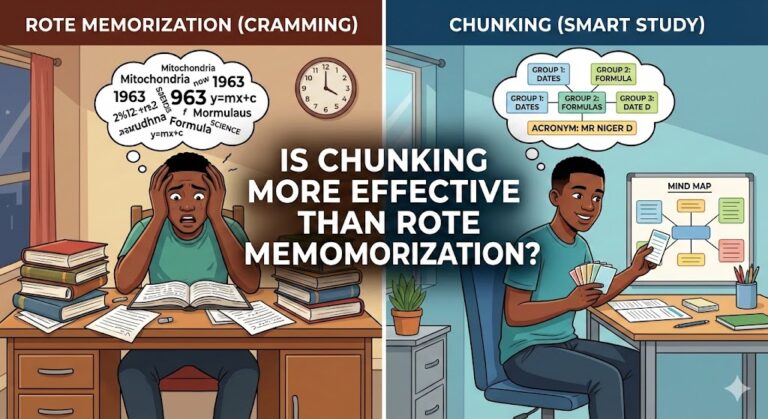
Most Nigerian students rely on “cramming.” We call it “La Cram, La Pour.” You stuff information in, pour it out on the exam sheet, and forget it five minutes later. That might work for a class test, but for massive exams like JAMB or WAEC, it’s a disaster waiting to happen.
If you want to actually retain information, you need a strategy shift. Here are 9 memorization tips for studying that will help you move from cramming to actual understanding.

1. The Feynman Technique (Teach It to a Wall)
This is hands down the most powerful trick in the book.
The idea is simple: You don’t truly understand a topic until you can explain it in simple English to someone else. Albert Einstein reportedly said, “If you can’t explain it simply, you don’t understand it well enough.”
After you finish a chapter on Government or Economics, close the textbook. Pretend you are the teacher. Stand in front of your empty room (or grab your younger sibling if they aren’t busy) and teach the topic.
If you stumble or have to check the book, that’s a gap in your knowledge. Go back and re-read that specific part.
2. Use Active Recall (Close the Book)
A lot of students think “studying” means reading their note over and over again.
Let me be honest, that is a waste of time. Passive reading feels like you are learning because the words look familiar. But you aren’t building memory pathways.
Instead, use Active Recall.
-
Read a paragraph.
-
Look away.
-
Ask yourself: “What did I just read?”
-
Answer out loud without looking.
It feels harder than just reading. It might even feel frustrating. But that struggle is your brain actually working to store the information.
3. Spaced Repetition (Beat the Forgetting Curve)
Imagine you want to clear a bush path. If you walk through it once, the grass grows back immediately. If you walk through it every day, a clear path forms.
Your brain works the same way.
Don’t read a topic for 5 hours in one day and then abandon it for a month. You will forget 80% of it. Instead, break it down. Read for 30 minutes today. Review it for 10 minutes tomorrow. Review it again in three days.
This is critical when you are looking at heavy subjects. For example, when tackling the JAMB syllabus 2026 for Biology topics you must read to score high, you can’t rush it. You need to space out the topics over weeks to make them stick.
4. Acronyms and Mnemonics (The “MR NIGER D” Strategy)
We all remember the characteristics of living things because of “MR NIGER D,” right?
-
Movement
-
Respiration
-
Nutrition… and so on.
That is a mnemonic. It works because the brain loves patterns. If you have a list of points to memorize for a debate or an essay, create a funny word or sentence out of the first letters.
The sillier the sentence, the easier it is to remember. If you are preparing for a debate, like whether mixed school is better than single school, memorize your main points using a catchy acronym so you don’t freeze on stage.
5. Use Past Questions as Study Tools
Don’t wait until two weeks to the exam to open past questions.
Using past questions is a form of Active Recall. It forces you to retrieve information. Even if you get the answer wrong, the shock of failing the question helps you remember the right answer later.
There is a popular saying: “WAEC doesn’t change questions, they just recycle them.” While that’s an exaggeration, the concepts remain the same.
Recommended: Price of JAMB form 2026: Official cost breakdown & registration guide
6. Sleep is Not for the Weak (It’s for Memory)
I know the culture. “No sleep for the wicked.” “Jackometer.”
But here is the science: Your brain moves information from short-term memory to long-term memory while you sleep. If you study till 4 AM and only sleep for two hours, you have effectively deleted half of what you studied.
According to the Sleep Foundation, teenagers actually need about 8 to 10 hours of sleep to function at their peak. I know that’s hard with school stress, but try to get at least 6 solid hours. Your brain needs to defragment.
7. Mix Up Your Subjects (Interleaving)
It feels logical to study Mathematics all day on Monday, then English all day on Tuesday.
But research suggests that “Interleaving”—mixing subjects up—is better. Study Math for one hour, then switch to Chemistry for an hour.
Why? It keeps your brain alert. Staying on one topic for too long leads to boredom and “autopilot” mode. Switching subjects forces your brain to constantly adapt, which strengthens connections.
8. Visualize the Concept
Humans are visual creatures. We remember images better than text.
If you are reading about the Nigerian Civil War in Government, don’t just read the dates. Picture the map. Visualize the key actors.
If you are studying Biology, draw the diagram of the heart. Don’t just look at it in the textbook; draw it yourself. Ugly drawings are fine. The act of drawing creates a “spatial” memory that is harder to forget.
This connects to how we learn in the classroom. Sometimes, teachers are responsible for students’ failure because they don’t use enough visual aids. But as a student, you have to take charge of your own learning. Draw it out.
9. Eat Brain-Boosting Foods
You cannot fuel a Ferrari with kerosene. You cannot fuel a brain preparing for JAMB with just Gala and Lacasera.
Your brain uses 20% of your body’s energy. Try to eat foods rich in antioxidants and healthy fats. Things like:
-
Fish (Omega-3 is gold for memory).
-
Eggs.
-
Fruits (Oranges, Bananas).
-
Dark leafy vegetables (Ugu, Spinach).
Harvard Health confirms that nutrition directly impacts cognitive function. So, before you hit the books, drink water and eat something decent.
Wrapping It Up
There is no magic pill for passing exams. It takes work.
But working hard isn’t the same as working smart. If you are reading for 10 hours but using the wrong methods, you will still struggle. Pick two or three tips from this list—maybe start with the Feynman Technique and Active Recall—and try them this week.
You will notice the difference. The material will start to stick, and that panic in the exam hall will disappear.