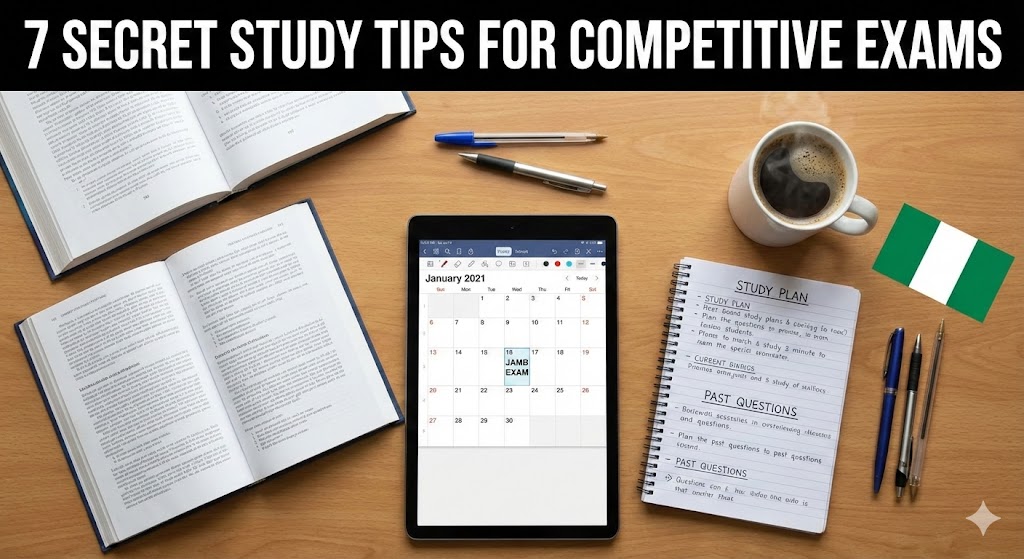
7 Secret Study Tips for Competitive Exams: Ace WAEC & JAMB Without Burning Out
7 Secret Study Tips for Competitive Exams: Ace WAEC & JAMB Without Burning Out
We’ve all been there. It’s two weeks to JAMB or WAEC, the generator is making noise outside, and you are staring at a chemistry textbook feeling like your brain is full of cotton wool. You’re stressed. You’re tired. And honestly? You’re scared of seeing a low score.
The problem isn’t usually that you aren’t reading enough. The problem is how you are reading.
Most students think studying means staring at a book for 10 hours until their eyes hurt. But that’s the hard way, not the smart way. If you want to smash those cut-off marks, you need a strategy. In this guide, I’m going to show you 7 secret study tips for competitive exams that actually work for Nigerian students. These aren’t magic tricks, but if you apply them, they might feel like it.

1. Stop “Just Reading” (The Trap of Passive Study)
Here is a mistake 90% of students make. You open your textbook, you read a chapter, you nod your head, and you say, “Okay, I understand.”
Do you, though?
Recognizing information is not the same as knowing it. When you just read, your brain is being passive. It’s like watching a football match and thinking you can now play for the Super Eagles just because you watched them play.
What to do instead: Use Active Recall. After reading a page, close the book. Look away. Now, try to say out loud exactly what you just read. If you can’t remember it without peeking, you don’t know it yet. It’s tough, and your brain will fight you because it’s harder than just reading. But that struggle? That’s where the learning happens.
2. The “Teach It” Method (Feynman Technique)
Have you ever noticed that the smartest guy in class is usually the one explaining things to everyone else? There’s a reason for that.
When you teach a topic, you force your brain to organize the information logically. This is often called the Feynman Technique. You don’t need a real classroom to do this.
How to use it: Imagine you are teaching a Junior Secondary School student who knows nothing about the topic.
-
Grab a friend, your sibling, or even talk to the wall.
-
Explain the concept simply.
-
If you get stuck or use “big grammar” to cover up gaps, go back to your notes.
This is a proof-positive way to ensure you aren’t just memorizing definitions but actually understanding the concept. As we’ve discussed before, believing that hard work is more important than talent is key here—talent might help you understand quickly, but the hard work of explaining it cements it in your brain.
3. Past Questions Are Gold (But Don’t Memorize the Answers)
I cannot stress this enough. Competitive exams like JAMB and Post-UTME are notorious for repeating question patterns. However, there is a wrong way to use past questions.
Don’t just cram the answers: “1998 Question 4 is A.” That is a recipe for disaster. JAMB can twist that same question slightly, and if you only crammed the letter ‘A’, you will fail it.
The Strategy: Use past questions to test your speed and understanding.
-
Pick a year.
-
Time yourself.
-
Mark it honestly.
-
For every question you missed, go back to your textbook and study that specific topic.
You can find legitimate past questions and resources on platforms like the Joint Admissions and Matriculation Board (JAMB) portal or trustworthy educational apps.
4. Use the Syllabus as Your Bible
A lot of students read aimlessly. They pick up a textbook and start from page 1. But does JAMB or WAEC set questions from every single page? No.
They set questions based on their syllabus. If a topic isn’t in the syllabus, don’t waste your time on it—at least not for the exam.
Action Step: Get the official syllabus for every subject you are sitting for. Tick off topics as you master them. For example, if you are a science student, checking out the JAMB syllabus 2026 for Biology topics gives you a direct roadmap of exactly what you need to cover to score high. Don’t read blind.
5. Master the Art of Short Breaks (Pomodoro Technique)
“I read for 12 hours yesterday.”
I hear this brag all the time in hostels. But let’s be real—after hour 4, were you really absorbing anything? Or were you just looking at the pages while thinking about rice and stew?
Your brain has a limit. Trying to force it to focus for hours without a break leads to burnout.
Try the Pomodoro Technique:
-
Set a timer for 25 minutes.
-
Study hard with zero phone distractions.
-
When the timer rings, take a 5-minute break. Walk around, stretch, drink water.
-
Repeat.
This keeps your brain fresh. You can use a simple kitchen timer or free online tools like Pomofocus to keep track.
6. Fix Your Environment
I know, I know. Studying in Nigeria comes with its own challenges. You have siblings shouting, neighbors playing loud music, or the heat is just unbearable.
But you have to control what you can. You cannot study effectively if you are constantly distracted.
-
Find a “Focus Zone”: It could be a corner of the library, an empty classroom after school, or just your room late at night when everyone is asleep.
-
Kill the Phone: Put your phone in another room. If you are using it to study, turn on “Do Not Disturb.” You don’t want to be in the middle of a complex math problem and get distracted because you are trying to fix profile code or NIN errors. Sort those technical issues out separately so your study time is pure study time.
7. Consistency Beats “Crash Reading”
The biggest lie students tell themselves is, “I work better under pressure.”
No, you don’t. You just panic fast. “Fire brigade” approach—trying to cram two years of work into two weeks—rarely ends well. The secret to success in competitive exams isn’t intensity; it’s consistency.
Reading 2 hours every single day for 3 months is far better than reading 15 hours a day for one week. Your brain needs time to move information from short-term memory to long-term memory (that’s where it needs to be for the exam hall).
Conclusion
Passing these exams doesn’t require you to be a genius. It requires you to be disciplined.
Don’t let the pressure overwhelm you. Pick one or two of these 7 secret study tips for competitive exams and start using them today. Maybe start with the active recall, or download that syllabus.
You’ve got this. Good luck!


