7 Secret Methods for Studying for Exams: How to Smash WAEC & JAMB Without “Crashing”
7 Secret Methods for Studying for Exams: How to Smash WAEC & JAMB Without “Crashing”
Let’s be honest for a second. The pressure to pass exams in Nigeria is crazy. Whether you are facing WAEC, NECO, or the dreaded JAMB UTME, the fear of seeing a “F9” or a low score can keep you awake for nights. You see your guys going for “TDB” (Till Day Break) at the library, and you feel like you aren’t doing enough.
But here is the problem: staring at your book for 10 hours doesn’t mean you are actually learning.
I used to be that student who would read from morning till night, yet when I entered the exam hall, my brain would go blank. It was frustrating. I realized later that I wasn’t studying smart; I was just stressing my brain. Over time, I discovered 7 secret methods for studying for exams that completely changed my grades. These aren’t magic tricks, but they work better than just reading your textbook over and over again.
If you are tired of reading hard but scoring average, this guide is for you.

1. Use Active Recall (Stop Just Reading)
Most students study by reading a page, highlighting it, and reading it again.
That feels good because the information becomes familiar. But familiar doesn’t mean you know it. This is the biggest trap students fall into.
Active Recall is different. It forces your brain to work.
Here is how to do it: Read a section of your textbook. Then, close the book. Look away and try to say out loud exactly what you just read without peeking.
If you can’t say it, you don’t know it. It’s that simple. It feels harder than just reading, but that struggle is where the learning happens. It’s like lifting heavy weights at the gym; it hurts, but that’s how the muscle grows.
2. The “Teach It To A Child” Trick
This is often called the Feynman Technique, named after a smart physicist, but let’s keep it local.
Imagine you are trying to explain a topic—say, “Photosynthesis”—to your 10-year-old junior brother. You can’t use big grammar. You can’t use complex jargon. You have to break it down simply.
If you can’t explain a concept in simple English, you don’t understand it well enough.
Try this next time you are studying for Biology. Instead of memorizing definitions, try to teach the concept to an empty chair or your room mirror. If you get stuck, open your book, fill the gap, and try again. This method exposes your weak points instantly.
For more on tackling specific subjects, check out our guide on the JAMB syllabus 2026 for Biology and the topics you must read to score high. Knowing the topics is step one; being able to teach them is step two.
3. Master The Syllabus (Don’t Read Blindly)
One mistake I see every year is students reading topics that aren’t even in the exam.
WAEC and JAMB are not setting questions from the moon. They set questions based on a syllabus. If you are reading a topic that JAMB has removed from the syllabus, you are wasting precious time.
Before you start your serious study plan, get the official syllabus. Tick off topics as you conquer them. This gives you a roadmap. You wouldn’t travel from Lagos to Abuja without a map, so why write an exam without one?
Also, don’t let registration stress distract you from the syllabus. Sort out your JAMB registration issues and profile code errors early so your mind is clear for studying.
4. Spaced Repetition (The Cure for “La Cram, La Pour”)
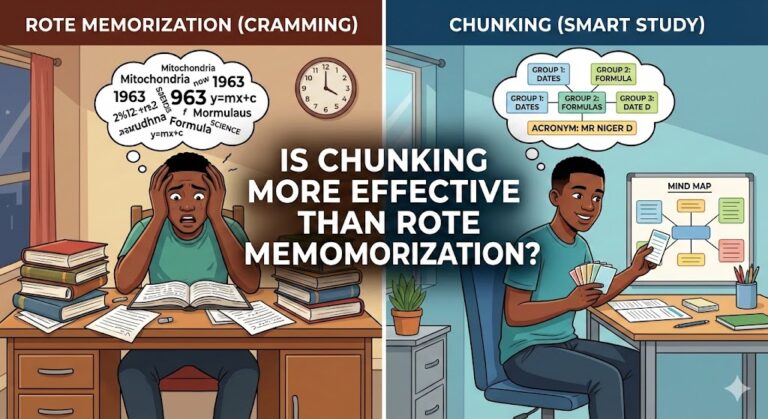
We all know the “Cram and Pour” gang. They memorize the whole notebook the night before.
They might pass that specific test, but ask them a week later, and they remember nothing. This is dangerous for exams like JAMB where you need to remember things you learned in SS1, SS2, and SS3.
Spaced Repetition beats cramming every time.
Instead of reading a topic for 5 hours on Monday and never looking at it again, read it for 30 minutes on Monday, 10 minutes on Wednesday, and 5 minutes on Friday.
Your brain needs to almost forget something to strengthen the memory of it. By reviewing the material at intervals, you move it from your short-term memory to your long-term memory. There are apps like Anki that help with this, or you can just use a simple timetable.
5. Simulate The Exam Hall Conditions
The exam hall is a scary place. It’s quiet, the invigilators are watching, and the clock is ticking.
If you only study while lying on your bed with music playing and snacks in your hand, you are setting yourself up for shock.
Among the 7 secret methods for studying for exams, this is the one that builds confidence.
Get a set of past questions. Set a timer for exactly the duration of the real exam. Sit at a desk. Remove your phone. Start.
Force yourself to answer the questions under pressure. This trains your brain to function when you are anxious. It also helps you figure out your timing. You don’t want to be the student shouting “Please sir, just one minute more!” when the time is up.
If you are preparing for common entrance or transfer exams, you can apply this same logic. Check if the Unity School transfer form is out and start practicing with past questions immediately.
6. The Pomodoro Technique (Beat Distractions)
Let’s be real: our attention spans are short.
You plan to read for 3 hours, but 15 minutes later, you are pressing your phone or checking WhatsApp status.
Try the Pomodoro Technique.
-
Set a timer for 25 minutes.
-
Study hard for those 25 minutes. No phone. No talking.
-
When the timer rings, take a 5-minute break. Walk around, drink water, reply to a text.
-
Repeat.
It is easier to tell your brain, “Focus for just 25 minutes,” than “Focus for 4 hours.” This keeps your brain fresh and prevents burnout.
You can read more about how effective time management works on Cornell University’s learning strategies page.
7. Sleep Is Part of Studying
This sounds counter-intuitive, right?
In Nigeria, we praise students who read overnight every day. But science shows that sleep is when your brain actually saves what you have learned.
If you study for 12 hours and sleep for 2 hours, you will forget most of what you read. It’s a waste of effort. Your brain needs rest to organize information.
So, don’t feel guilty for sleeping. Just make sure you studied before you slept. Remember, hard work is more important than talent, but smart work (including rest) keeps you going.
According to the Sleep Foundation, teenagers actually need between 8 to 10 hours of sleep to function properly—so don’t cheat your brain.
Conclusion
Passing exams in Nigeria isn’t just about who is the smartest. It’s about who prepares the best.
These 7 secret methods for studying for exams are tools. You have to pick them up and use them. Don’t just be a “Cram and Pour” student. Be strategic. Use active recall, manage your time, and please, get some sleep.
Which of these methods have you tried before? Or do you have a special study style that works for you? Let me know in the comments section below!